

Last night, Channel 4 News ran a five-minute piece by Alex Thomson dubbing our basalt trial "the magic dust saving trees and reducing carbon emissions" — and setting it against a backdrop of the UK's increasingly frequent, increasingly intense heatwaves, and the growing need for forests that can absorb more CO₂. It's a good hook, and it sent a lot of people to our website wanting to know more. So here's the fuller story behind the "magic dust": what it actually is, what our data show it's doing, and why the full explanation is arguably even more interesting than the headline.
The "dust" in question isn't magic at all — it's basaltic andesite, a by product of quarrying. Every year, quarries across the UK produce vast quantities of crushed rock left over once the primary material has been extracted for construction. At Builth Wells Quarry, about 35km from our research site in Carmarthenshire, that by product is exactly the fine, unglamorous rock dust most people would walk straight past.
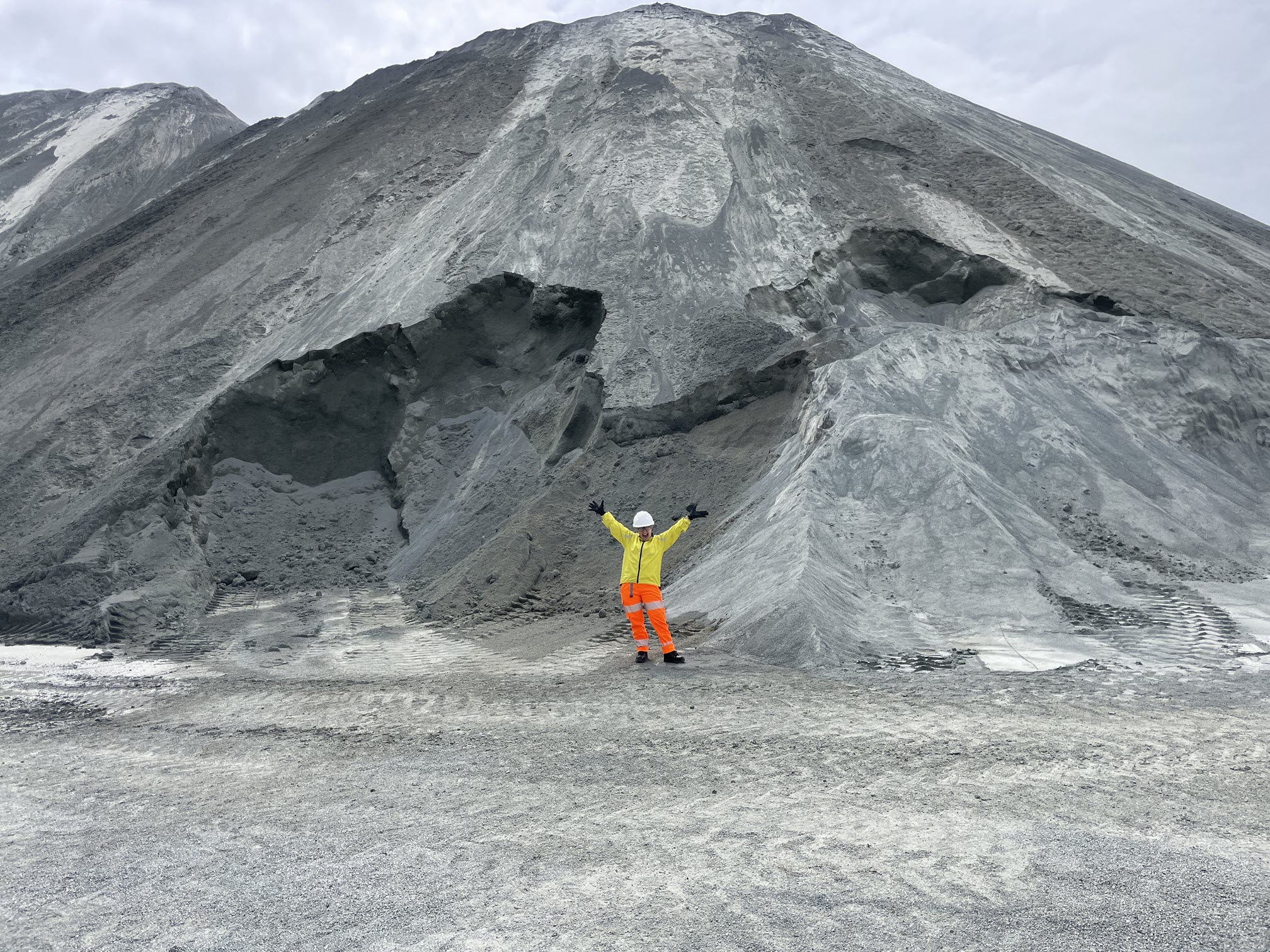
We didn't walk past it. Over the past five years, that basalt has become central to one of the questions we set out to answer at Glandwr Forest: can spreading crushed silicate rock onto newly planted woodland help trees grow faster and store more carbon?
We now have our first four years of results, published this month in Communications Sustainability — and they tell a more interesting story than "magic dust" alone suggests.
Enhanced rock weathering (ERW) — the practice of applying crushed silicate rock like basalt to soil, where it slowly reacts with rainwater and locks away atmospheric CO₂ as it dissolves — has strong support from lab and pot-based studies. But as our scientific lead, Dr Bonnie Waring of Imperial College London put it when we caught up with her on site recently, the real question for land managers is different: does it actually work at field scale, in real soils, with all the weather and variability that involves?
That's what Glandwr was built to test. At 11.5 hectares, with over 25,000 trees planted and 6,400 individually monitored across 72 plots, it's the largest and most highly replicated field trial of its kind anywhere in the world. That scale matters. Effects that are real but modest can be easy to miss in a small trial and easy to mistake for noise. With this many plots and this many trees, we could be confident the patterns we found were genuine — not an artefact of one especially good or bad corner of the site.
It's worth pausing on how this data actually got collected. Over 300 citizen scientists have joined our Big Tree Measure since 2021, taking more than 75,000 individual measurements between them for this paper — in all weathers, year after year. Every basal diameter, every height, every barcode scan that fed into this paper was the product of someone giving up their time. The scale that made this study statistically credible is, in a very direct sense, a volunteer achievement.
Here's the finding we think matters most. ERW is usually framed as a carbon removal technology — rock reacts with rainwater, CO₂ gets converted into bicarbonate, carbon is locked away in the ocean for a millennium or more. That's real, and our data support it. But it turns out that's not the main way ERW showed up in our results.
What we found in addition is that crushed basalt made the trees themselves grow more. In our broadleaf plots — alder, aspen, birch, cherry, oak and rowan — aboveground carbon stocks were 27% higher in ERW-treated plots than in untreated controls after four years, an extra 787 kg of carbon per hectare. Individual tree growth across the whole trial increased by around 10% on average. And this effect didn't fade — it grew stronger with each passing year, likely helped by a second rock application in 2023.
As Bonnie told us, this changes the conversation about ERW as a carbon removal strategy, because it puts the role of the trees themselves front and centre.
We could see the mechanism at work in the soil chemistry. As the basalt weathered, it released calcium directly into the ground — calcium concentrations in buried rock samples dropped 44% over a year — and it raised soil pH from around 5.3 to 6.45. At the acidic end of that range, nutrients like nitrogen and phosphorus become harder for roots to access; nudging the pH up made existing soil nutrients more available, beyond what the rock itself contained. In effect, basalt acted as a slow-release fertiliser as much as a carbon capture tool.
Interestingly, this benefit was clear in broadleaf stands but not statistically robust in our spruce plots — a reminder that response to ERW isn't uniform across every forest type, and that soil chemistry and species matter. Because the mechanism depends on nutrient availability at lower pH, we'd also expect ERW to matter most on acidic soils rather than being a universal fix for any planting site — something we'll be exploring further as this research continues.
It's important to be clear about what these results do and don't show. This is our first published dataset from Glandwr, and it covers carbon stored above ground in the trees themselves over four years. We haven't yet fully quantified what's happening below ground — soil carbon, root systems, changes in soil respiration — and that's next on our list. Based on how quickly calcium was released from our buried rock samples, we estimate the weathering process itself could be removing a further 200–320 kg of carbon per hectare per year directly from the atmosphere, on top of the tree growth effect — but we're treating that as a provisional, upper-bound estimate until we can measure it properly, since the rock grain size we used to test weathering rates was finer than what was actually applied in the field.
There's a nice piece of external support for staying patient here: a wollastonite trial in a mature New Hampshire forest found a single rock application was still boosting tree carbon uptake fifteen years later. If something similar holds at Glandwr, the real payoff from this basalt application may still be ahead of us.
Bonnie's own next steps chime with ours: we need to understand which site characteristics — soil type, pH, rainfall — make a location a good candidate for ERW, and the only way to do that is to run this kind of trial in more places. We're already thinking about what a UK-wide network of parallel experiments could look like, each smaller than Glandwr but collectively building the evidence base that foresters and policymakers actually need.
For now, though, the headline is simple. Channel 4 was right that this unglamorous pile of rock dust at the quarry gate matters for a warming, drought-prone UK — but not just as a slow, steady carbon sink. Our data suggest its bigger job, at least in these first four years, is as a vitamin shot for trees: helping young woodland establish itself faster and store more carbon in its wood, right when that resilience is needed most.
Watch Channel 4 News's report, "The 'magic dust' saving trees and reducing carbon emission," here. The Glandwr Forest Carbon Study is a collaboration between The Carbon Community, Imperial College London, the University of Sheffield, the Royal Botanic Gardens Kew, and ETH Zurich. Read the full paper, "Microbiome manipulation and enhanced weathering influence tree growth in reforestation" in Communications Sustainability or click here.
Learn more about the work of volunteers and scientists on site at The Glandwr Forest.