

.jpg)
“Wonder is the beginning of wisdom”, Socrates
2025 brought intense, sometimes conflicting weather conditions: Storm Éowyn in January, months of heavy rain, and then four separate heatwaves and prolonged dry spells. At Glandwr Forest, we have mourned the loss of some favourite trees and marvelled at how nature has found a way to thrive.
.jpg)
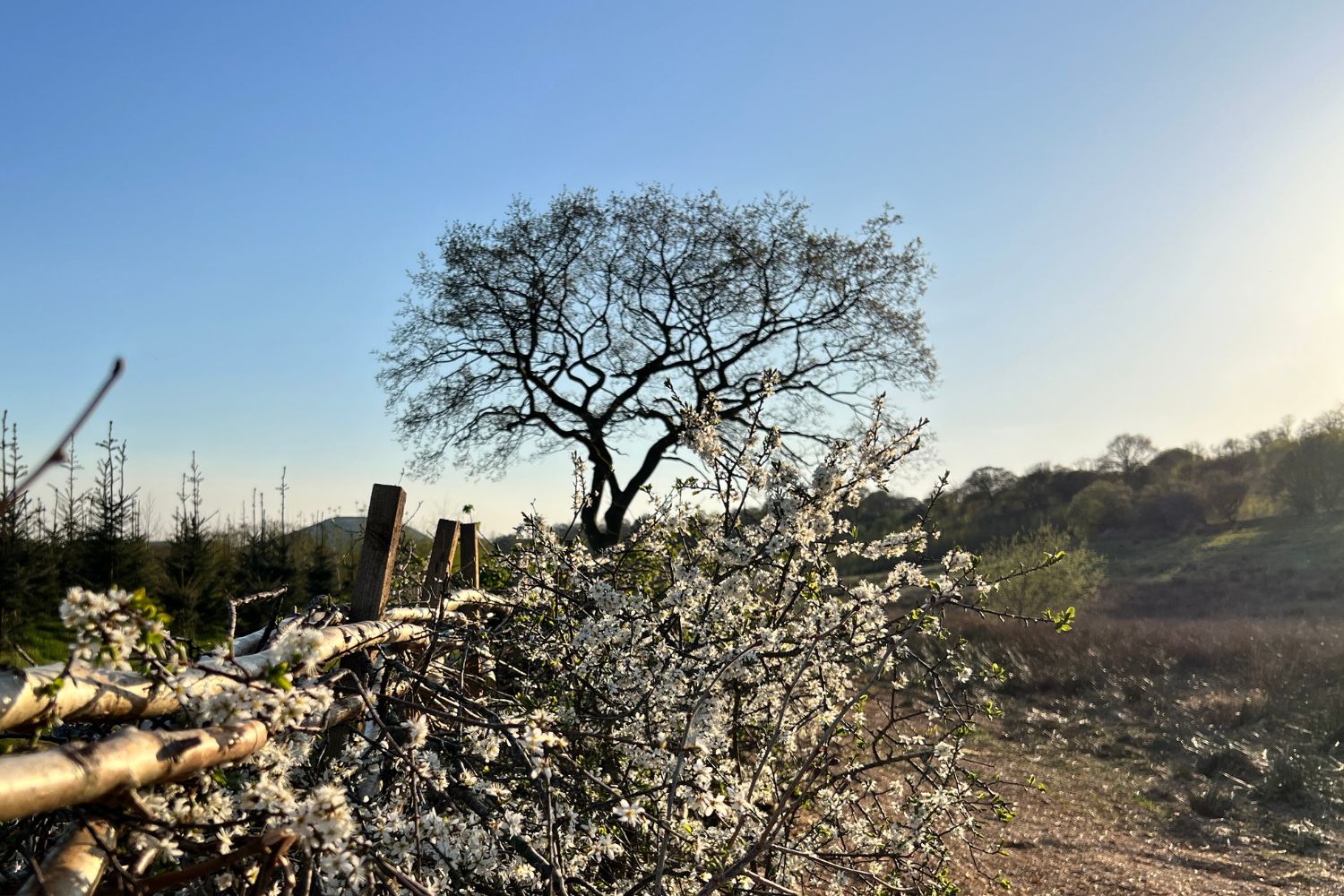
Glandwr Forest is home to beautiful lines of mature Oak hedgerow trees, dense rows of Hazel and our new edible hedge planted in 2023. In fact, over 15% of the site is made up of mature hedgerow trees, which are a critical source of site native regeneration, as well as offering valuable habitat for lichens, insects and more.
2025 began with a session on Brecon-style hedge-laying. The goal was to learn new skills and transform an overgrown hazel hedge laid decades earlier. Hedgerows are rich wildlife corridors that weave across the landscape. Over January and February 2025, over 560 metres of hedge and hedgebank were laid, coppiced, created or enriched with minor native species such as dogwood, guelder rose and alder buckthorn.
The new woodlands at Glandwr Forest were carefully designed to fit into the landscape and were planted on the least biodiverse areas of the site. Areas identified as being either of landscape significance or biodiversity value were left unplanted.
This year, the “Connected Trees and Woodlands” project enabled a whole-site vision that links hedgerows, hedgerow trees, new woodland, areas of natural regeneration and species-rich grasslands into one coherent habitat network. Thanks to new stockproof fencing and water sources, we can now introduce conservation grazing in areas we were previously unable to manage. Doublefencing has been put in place to protect mature hedgerow trees from browsing, soil compaction and eutrophication; and to facilitate natural regeneration.
Alongside this, a 20-year woodland management plan is now in place. The long-term vision includes management of the forest on a continuous cover basis, to develop a more uneven age structure. Management of the woodlands will include opportunities for coppicing to provide canopy gaps and mowing of rides through the trees will provide ample woodland corridors and edge habitat for invertebrates, mammals and woodland flowering plants. Where deadwood and fallen trees do not pose a risk to people or an impediment to access, it will be left to provide habitat for saprophytic fungi and insects.
This project was supported by the Welsh Government’s National Forest for Wales Landscape Pilot 2024/2025, administered by WCVA via Carmarthenshire Nature Partnership.
.jpg)
2025 was also a year of public recognition. At the Royal Welsh Show, Glandwr Woodland won a Gold Medal in the national woodlands competition for Broadleaf Planting or Restocking under Ten Years Old, competing against previous regional gold medallists from 2021–2024. This award celebrates the careful design and stewardship of the woodland and reflects the contribution of everyone who has planted, measured, and cared for trees.
.jpg)
I have been doing this since 2020. From initial planting, measuring, now hedging I love the area, the impact it is having and watching the growth and development. These trees have become my family.
Walking through Glandwr Forest, you may find yourself surrounded the rustle of leaves, birdsong, bees, fungi, lichen, the majestic canopy overhead, and new regeneration around your ankles. Trees at Glandwr are thriving with many of the broadleaf trees in our research area now over 5 metres tall.
.jpg)
Over 650 new trees were planted at Glandwr Forest in 2025 including new hedgerow trees in some of our newly created hedge banks; filling in gaps along our laid hedgerows; Black Poplar conservation; and replacing and remeasuring trees in our research areas. Some of our newly planted trees survived the first, second and third drought only to be caught in the fourth. Conditions were particularly challenging for trees planted close to the ridge that runs along the public footpath. Here, sun and wind exposure, thin topsoil and lack of water make it tough. In other areas, newly planted trees have pushed through the difficult circumstances and thrived.
.jpg)
Just over 100,000 trees have been planted at Glandwr, with the majority planted in 2021. At the time of planting, we agonised over the choice of tree shelters necessary to protect young broadleaf trees from rabbits and hares. In the end, we chose to use locally produced, recycled-plastic shelters that were affordable, strong enough for the Welsh winds, and recyclable in a closed-loop system. We also made a commitment to ensure that all the plastic was removed when the trees were ready. And now the time has come, many of the trees are now large enough. In April, 3,200 tree shelters were removed by our community science volunteers and nested before heading out to be recycled.
.jpg)
As we reached the autumn, we welcomed seed collection at Glandwr Forest for Hazel, Blackthorn, Crab Apple and Rowan. The weather has also led to a mast year for the Oak at Glandwr. The carpet of acorns beneath the mature trees will feed many small mammals this winter, and will also ensure that some are able to germinate into the next generation.
.jpg)
Thank you, Glandwr Forest, for another year of wonder and weaving new connections.
To follow our progress at Glandwr Forest, sign up for our latest news.